
Oakland Parole and Probation
Parole means a person has left a Michigan prison but remains in the legal custody and control of the Michigan Department of Corrections. It is a prison-release status, not the final end of the sentence. Probation is supervision imposed by a court. It may follow a county-jail term, accompany a suspended jail term, or begin without any prison stay. Both can place a person in the community under rules, but they arise from different authorities and use different records.
A person who bonded out of Oakland County Jail is not automatically on probation. Bond conditions belong to the pending court case. Likewise, a move from a jail bed to tether or a community program may leave restrictions in force without creating MDOC parole. Use the court order for probation or pretrial conditions. Use an OTIS parole status and Date Paroled for a state-prison exit.
| Status | Starting event | Best confirmation |
|---|---|---|
| Parole | Release from an MDOC prison into community supervision | OTIS Date Paroled, current status, and the assigned parole office |
| Probation | A sentencing court places the person under supervision | Court probation order, OTIS when MDOC-supervised, and the assigned probation office |
| Pretrial supervision | A court permits release while a criminal case remains pending | Bond order, court docket, and Oakland Pretrial Services |
| Discharge | The supervising authority's jurisdiction ends for that sentence | OTIS Discharge Date or a court discharge order |
- Parole
- Community supervision after release from state prison.
- Probation
- Court-ordered supervision that does not require a prior prison release.
- Discharge
- The end of supervision or MDOC jurisdiction for the listed sentence.
- Absconder
- A person alleged to have stopped reporting or left supervision without authorization.
Check Oakland Supervision Status
The Michigan OTIS search covers prisoners, parolees, probationers, and people within the agency's public post-discharge period. It does not cover a person whose only custody was an Oakland County jail or municipal lockup. Search results therefore need a custody classification before they can be read correctly. A missing OTIS result is not proof that no probation order exists.
- Search with the six-digit MDOC number when available. Otherwise use the last name, first name, and careful identity filters.
- Review Parolees, Probationers, or Discharged status as the known facts require. Compare aliases, birth information, Oakland conviction county, and court file.
- Read Current Status, Date Paroled, Discharge Date, sentence status, and the named supervision office. Do not treat the earliest release date as proof of an actual prison exit.
- Compare probation with the Oakland court's register of actions and order. The court document controls the legal terms.
- Contact the matching Region 10 office for routine status or reporting questions. Preserve the exact database wording and lookup date.
MI-VINE can add a custody-change notice, including a release or transfer alert. It is not a permanent supervision ledger. A VINE alert should be compared with OTIS, the court record, and the responsible Oakland office because release from one agency can lead to another form of custody or control.
Oakland Supervision Office Routing
MDOC Region 10 divides Oakland work by supervision type and location. The central Michigan Parole Board decides parole matters, but it is not the routine check-in office for a person already supervised in the county. Pontiac Parole handles parole contacts, while the Oakland and Troy offices handle probation assignments. Region 10 Northwest Operations coordinates the area.
The official Region 10 directory shows the office names, addresses, and telephone numbers reproduced below. Match the office to the OTIS record or court assignment before calling.
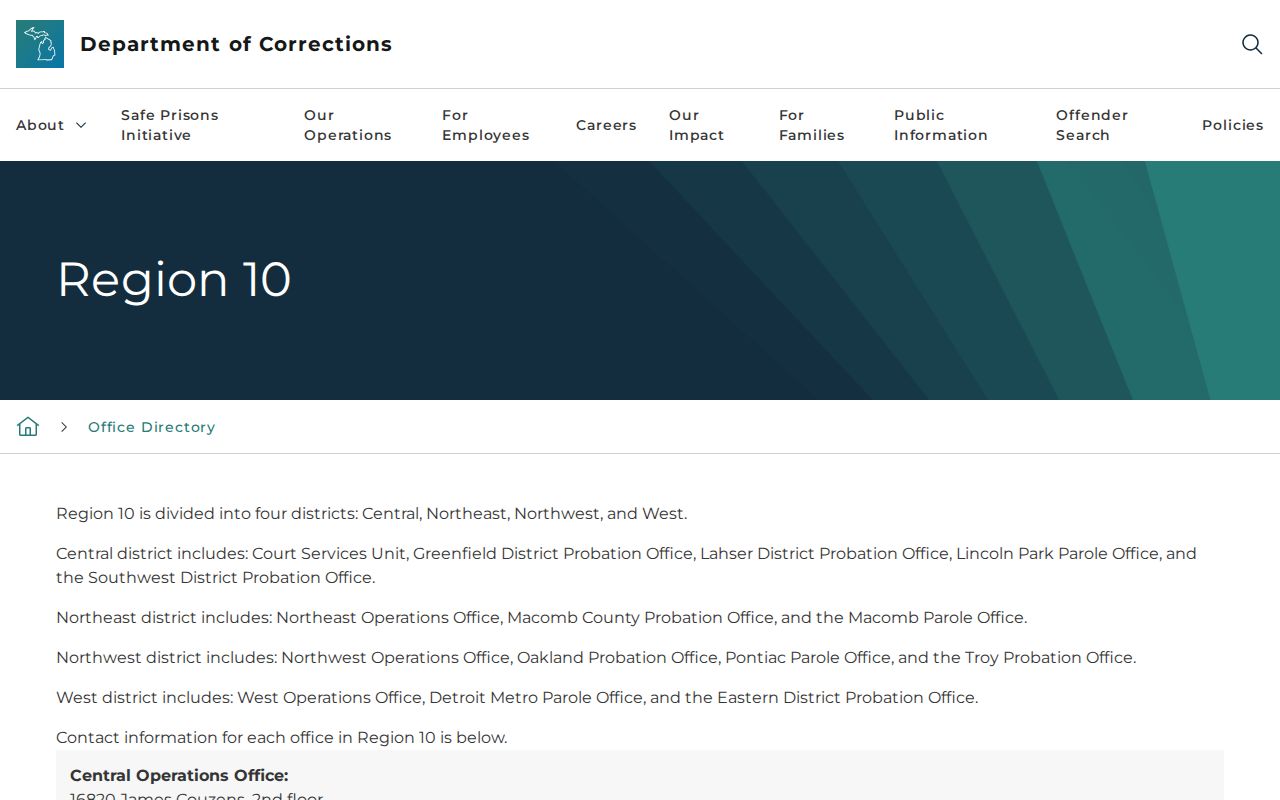
The directory is the best starting point for local reporting, agent, and assignment questions because the office split is more precise than a general statewide contact.
1200 North Telegraph Road, Building 26
Pontiac, MI 48341
248-858-0303
1200 North Telegraph Road, Building 26
Pontiac, MI 48341
248-858-0300
235 North Saginaw Street, Suite 100
Pontiac, MI 48342
248-253-2440
1151 Crooks Road
Troy, MI 48084
248-655-1100
Oakland Absconder Record Meaning
An absconder label means supervision has not ended normally. OTIS separates a parole absconder, pursued under MDOC authority, from a probation absconder under the sentencing county's jurisdiction. The correct status filter and office matter. MDOC's Most Wanted page is not a complete list of everyone released in Oakland County, and statewide legislative reports present aggregate counts rather than a named local history.
Do not convert an absconder entry into a claim about a new conviction. It describes an alleged supervision failure or unresolved reporting status. Verify the current record with Pontiac Parole for a parole case or the assigned probation office for a probation case. The MDOC escapee and absconder tip line is 517-755-0855, but ordinary questions belong with the supervising office.
Supervision can also change because of a court order, violation decision, transfer between offices, or discharge. Record the exact date and status shown. A stale screenshot can miss a later correction.
Oakland Parole Hearing Limits
The Michigan Parole Board is the sole paroling authority for felony offenders committed to MDOC. Under MCL 791.234, reaching the governing minimum gives the Board jurisdiction in an ordinary indeterminate case. It does not create a guaranteed release date. A grant authorizes planned parole, a denial rejects release at that review, and a deferral postpones a decision for more information, treatment, investigation, discussion, or placement. Even a grant does not prove the person physically left prison. OTIS Date Paroled supplies that evidence.
Michigan does not publish a complete calendar of routine parole interviews. The public registration list covers Lifer Law, commutation, and pardon public hearings, not every routine parole or returned-violator matter. Registration is due no later than two business days before a listed hearing. Virtual attendees must join early, and recording, photography, or screenshots of the proceeding are prohibited.
There is also no public person-level decisions database for every routine case. Quarterly Parole Board Decisions Reports give totals for grants, denials, deferrals, reviews, guideline groups, and reasons. They cannot confirm what happened to one Oakland County person.
The reports follow rolling data windows rather than a live Oakland County calendar. January reports cover September through November, April covers December through February, July covers March through May, and October covers June through August. Those aggregate schedules help explain statewide Board activity but never identify a named person's release. Public-hearing notices generally appear through MDOC press releases about two weeks to 30 days before the event.
Note: Board eligibility, a hearing listing, and a grant are planning or decision facts; only the later custody record proves release.
Oakland Release Program Completions
The OCSO 2023 Annual Report recorded 773 completions across JAWS, cognitive-behavioral, home-confinement, and work-release-tether programs. It also attributed 18,961 jail-bed days saved to the covered programs and reported that medication-assisted-treatment participants received release planning. These are system totals. They do not establish that any named person completed a program or was unconditionally discharged.
That distinction matters in Oakland County. Home confinement and work-release tether can place someone outside a jail bed while court or program rules remain active. A program completion may lead to another legal status. Confirm it through the individual court order, CLEMIS release record, and any assigned supervision office instead of applying annual totals to a person.
Oakland Post-Release Mail Access
After release, a former Oakland inmate may use the inmate number and password at SmartInmate to download personal postal mail, messages, and photos at no charge. This is access for the former account holder, not a public records archive. The credentials should not be shared or used to obtain another person's private correspondence.
Questions about physical property go to OCSO Inmate Property at 248-858-8770. The sheriff does not publish a detailed pickup process on the cited page, so call before traveling. Digital account access and property return do not prove parole, probation, or discharge. They are release logistics that should be paired with the official supervision record.
When Oakland Supervision Ends
For an MDOC case, Current Status “Discharged” and the Discharge Date show the end of state jurisdiction for the listed sentence. OTIS explains that discharge can follow successful parole or probation completion, service of the prison maximum without parole, or death in the defined circumstance. A death discharge must never be described as a return to the community. Public OTIS information generally remains available for three years after discharge, subject to set-aside and other lawful limits.
For court probation, obtain the discharge or satisfaction order from the court that imposed supervision. Oakland misdemeanors remain in district court. Felonies begin there and move to Sixth Circuit after bindover. A jail roster cannot answer whether probation ended, and a missing OTIS record may reflect jail-only supervision, expiration of the public window, identity mismatch, or nonpublic status.
A two-source check is strongest: compare the discharge field or court order with the underlying sentence and the responsible office. The release record on the home page explains how custody dates and court events fit together.
If an OTIS field appears wrong, trace its source. Court-derived errors should be raised with the sentencing court. A supervision or absconder error belongs with the assigned parole or probation office, which can direct a correction. General accuracy concerns may be sent to CorrectionsInfo@michigan.gov. Do not rewrite an official status into a simpler label that changes its meaning.