
Official Oakland 72 Hour Releases
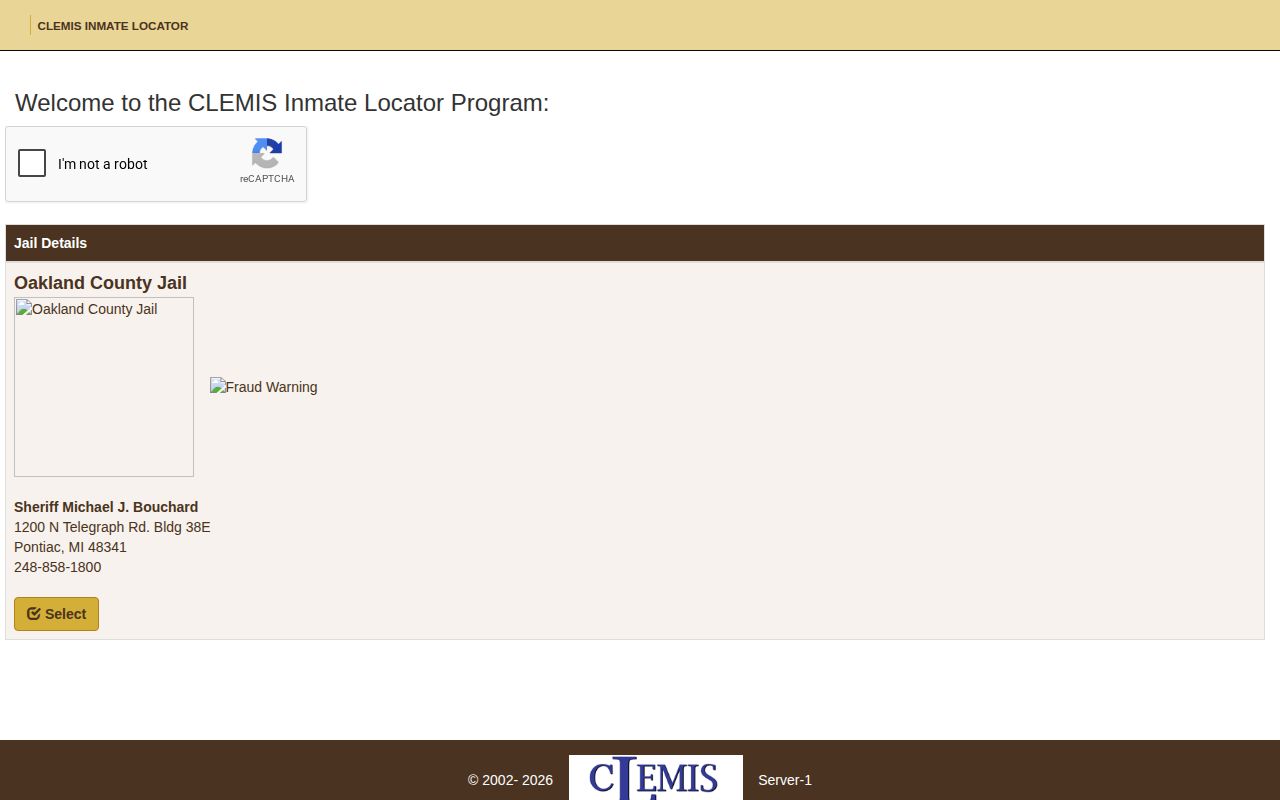
Oakland County has a genuine rolling release feed. Start at the sheriff’s Inmate Information page, then follow its link to CLEMIS. The locator requires reCAPTCHA and an Oakland County Jail selection before it shows the available views. Choose “released within the last 72 hours.” That label defines the public release window.
The view is not a complete historical archive. A person drops out once the rolling period passes, and the research found no longer public sheriff release database. It also is not a list of everyone who left every lockup in Oakland County. A municipal police department may release a person before county booking. A person transferred to MDOC or another authority ends the Oakland booking but has not necessarily returned to the community.
Check Oakland 72 Hour Releases
The official entry route should be used because the released-results path depends on a selected facility session. Search with enough identity detail to avoid confusing people who share a name.
- Open the CLEMIS Inmate Locator and complete the reCAPTCHA prompt.
- Select Oakland County Jail. Do not treat the Main Jail and Main Jail Annex as separate public release feeds.
- Choose “released within the last 72 hours,” not either of the current or recent incarceration views.
- Compare the name, inmate ID, date of birth, Book Date, and Released Date. Open Details for the larger image and repeated dates.
- Write down the exact lookup time. If no row appears, retry after a delay and contact OCSO Inmate Information at 248-858-1800 or PrisonerInfo@oakgov.com.
For a narrow same-day question, the Jail Releases: 24 Hours page explains how to compare the Released Date because Oakland does not supply a separate 24-hour release button.
Oakland 72 Hour Release Fields
The released table is designed for recent identity and date checking. It leaves out key legal and destination details. The visible inventory helps define what can and cannot be concluded from a row.
| Displayed field | Meaning and limit |
|---|---|
| Inmate name | Name attached to the recent Oakland County Jail booking. |
| Photo thumbnail | A booking-image preview, with a larger frontal image under Details. |
| Released Date | The displayed end date for that booking, not the release reason or destination. |
| Book Date | The date the booking began. It does not identify the case outcome. |
| Inmate ID | A local identifier useful for distinguishing similar names and making a record request. |
| Sex and DOB | Match aids that should be handled with restraint and current context. |
| Details | A modal that repeats identity and dates with a larger image. |
Charges, bond, holds, and release reason are not shown on this released branch. Ask the OCSO Records Unit for the existing booking/release record and compare it with the criminal case. A bond order, dismissal, sentence, or transfer order can explain why the booking ended, while the jail record can supply the physical release time.
The image fields also need source context. The thumbnail and larger frontal image belong to the booking shown in the recent table, but they do not state what happened in court or where the person went next. Keep the Released Date and Book Date with any identity check. Do not turn the short-lived view into an unnecessary permanent copy. If a photo is needed after the public window closes, request the booking photograph from OCSO Records and let the agency apply current exemptions, redactions, sealed status, and other access rules to that request.
The human CLEMIS released route provides the live table after Oakland County Jail has been selected. The captured interface below shows the official layout and recent-release columns.
The current feed, rather than the stored image, must be used for any present-day release check.
Note: The released table’s visible fields do not include the release reason, charges, bond, holds, or the person’s next destination.
Oakland Weekend Release Catch-Up
A three-day window is well suited to a weekend catch-up. A check made on Monday can retain rows from much of the weekend, depending on the exact hour each release was recorded. It also spans more than one calendar date, which helps when family or counsel knows that an exit occurred “over the weekend” but not whether it was late Friday, Saturday, or Sunday.
The window should not be stretched into a promise about holiday staffing or a guaranteed update time. Oakland’s warning says records may be up to 72 hours out of date depending on the day of week. If a known event is missing, record the search time, retry later, and call the jail. Once the release itself is more than 72 hours old, move to the records and court channels instead of waiting for it to reappear.
Note: A rolling 72-hour view changes by the hour, so a row seen early in the day may age out before a later check.
Oakland Release Data Lag
Two separate clocks govern the CLEMIS display. The browser client is configured to refresh every 300 seconds. That five-minute refresh reloads what the system can show. It does not guarantee that a new booking event entered the public source five minutes after jail staff acted. OCSO’s separate lag warning is the right measure of caution.
This difference between refresh and freshness is a distinctive Oakland data issue. A screen can reload and remain unchanged because the source record has not yet arrived. It can also retain an old status during the warned lag. A missing person may still be in the processing chain, and a displayed current-custody result may await an update. Direct confirmation is the right next step when timing matters.
Use the CLEMIS row as one source, then compare it with an OCSO answer or release record. For a legal event, check the court order as well. The sheriff record and court record serve different purposes: one documents the booking end, while the other records the legal authority or case action.
Reading Oakland Release Outcomes
“Released” in the table marks the end of the local booking. It does not publish the outcome. A bond release means the pending case continues under a court-set assurance to return. Time served or sentence expiration relates to the custodial term. A dismissal may remove one basis for detention but leave another case or hold. Each event has a different legal meaning.
| Possible outcome | Best confirming source | Community release? |
|---|---|---|
| Bond | Court bond order and OCSO release entry | Often, unless another hold applies |
| Time served | Judgment or sentence record plus OCSO entry | Only if no other authority takes custody |
| Dismissal | Court register and order | Not if another case or detainer remains |
| MDOC transfer | OCSO disposition, then OTIS | No, state custody continues |
| USMS or ICE transfer | OCSO disposition and federal channel | No, another authority has custody |
A transfer can remove someone from the Oakland jail list just as a community release can. Follow the destination. OTIS covers state prisoners, parolees, probationers, and recently discharged people, but it excludes county-jail-only cases. BOP covers sentenced federal custody. USMS has no public detainee locator, while ICE uses its own detention locator.
Older Oakland Release Records
After the 72-hour cutoff, contact OCSO rather than treating the missing row as a negative history. A former inmate can appear at the Records Unit with government-issued photo identification and the incarceration dates to request a free proof-of-incarceration letter. For a fuller public record, submit a county FOIA request that describes the booking, release date and time, disposition or reason, releasing authority, and any public transfer destination sought.
Ask for an existing, electronically delivered record and allow redaction where an exemption applies. The request should not demand a new narrative. For the legal disposition, search the right court. Oakland felony matters begin in district court and move to Sixth Circuit after bindover. Misdemeanors remain in the district court of jurisdiction. Court Explorer provides the circuit register of actions and public document ordering, but a court event may not show the precise time jail staff completed release.
An earlier MI-VINE alert can help establish when a status notice was sent, though Michigan does not promise permanent display of released records there. For a named-person search across county, state, and federal systems, use the complete Oakland County released-inmate search on Home.
Note: A court order can explain the legal basis for release, while the OCSO record is better for the completed custody time.
Oakland Released Versus Incarcerated
CLEMIS separates the recent-release branch from two incarceration branches. “All currently incarcerated” is the live custody view. “Incarcerated within the last 72 hours” identifies recent custody activity and must not be mistaken for release. Only “released within the last 72 hours” is the release feed.
A current match supports present Oakland custody subject to the lag notice. A released-row match supports the end of that booking, but its destination remains open until another source answers it. No match is inconclusive because the person may be outside the public window, booked by a municipal agency, transferred, entered under different identity data, or affected by data delay.
- Rolling window
- A view that adds new events and removes events as they pass the stated age.
- Release disposition
- The recorded reason or destination tied to the booking’s end.
- Detainer
- A request from another authority that can prevent community release.
- Proof of incarceration
- An OCSO letter documenting a former inmate’s custody dates.