
Michigan State Prison Release Scope
No operating MDOC prison was identified inside Oakland County in the official state directory. Oakland defendants sentenced to state prison can be placed anywhere in Michigan’s prison system. The physical county of the institution is therefore a poor filter for an Oakland conviction. “Oaks Correctional Facility” must not be included simply because its name resembles Oakland; it is in Manistee County.
A transfer from Oakland County Jail to MDOC is not a release to the community. It ends the county booking and begins state custody. From that point, the statewide Offender Tracking Information System, or OTIS, is the first public route. Later community supervision, prison discharge, records requests, and sentencing-court documents belong to the state-prison path, not CLEMIS.
Search Michigan Prison Releases
The official MDOC OTIS page covers prisoners, parolees, probationers under state supervision, and discharged people who remain in the public retention period. It does not cover Oakland County Jail-only cases or city lockups. Classify the custody before treating a no-match result as meaningful.
- Open the OTIS search form and enter the six-digit MDOC number when known.
- Without the number, enter the last name and first name. OTIS permits wildcard behavior after at least three initial last-name characters.
- Narrow with sex, race, approximate age, identifying marks, or status when needed.
- Select Parolees for a person believed released from prison into supervision, or Discharged for someone believed beyond MDOC jurisdiction.
- Compare aliases, MDOC and state identifiers, conviction county, court file, offense, and sentence before accepting the match.
- Record the lookup date and exact field labels, then confirm a completed exit with Date Paroled or an MDOC record.
The statewide search route is illustrated on the official OTIS page below. It shows the MDOC system used for Oakland County state-prison cases, not a county jail roster.
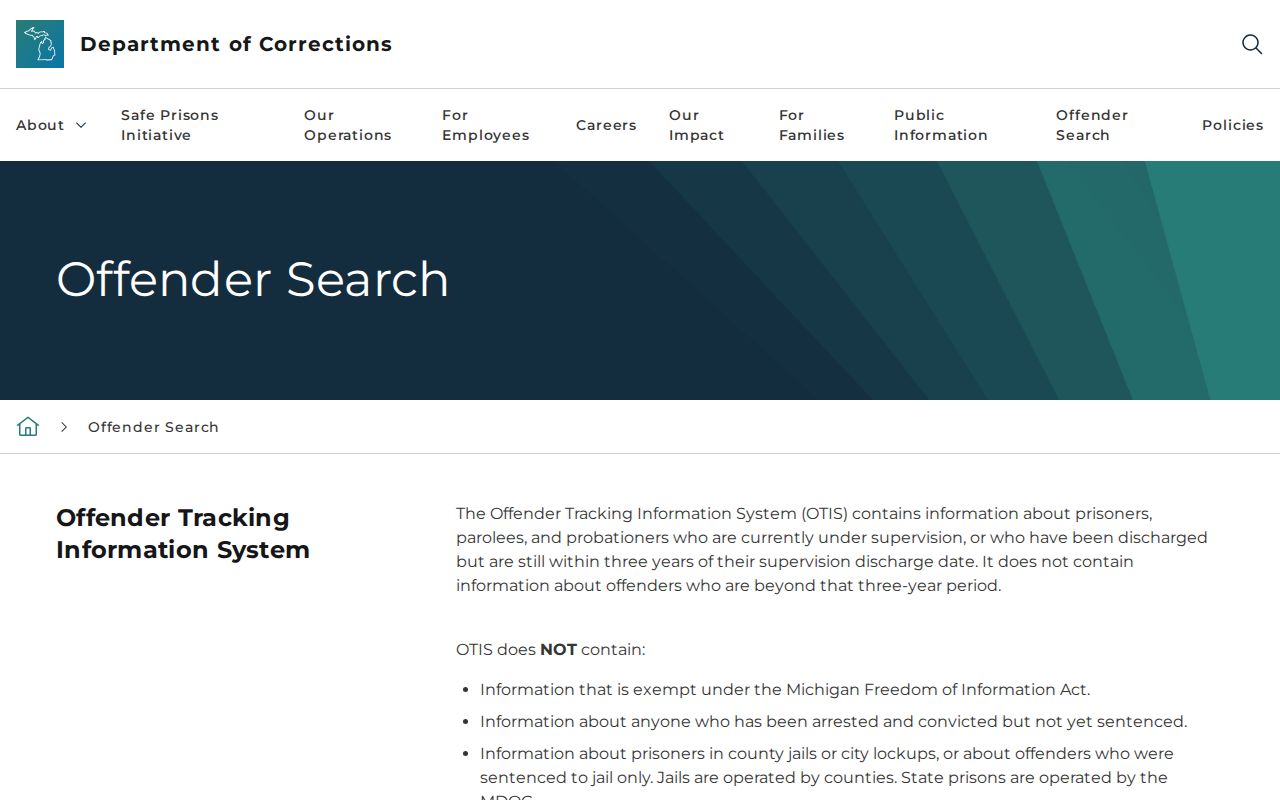
The live OTIS record and its current status must be read at the time of the search because location, supervision, and date information can change.
Michigan Prison Release Record Fields
OTIS profiles contain several date and status fields that answer different questions. The planning dates should not be substituted for the completed-event fields.
| OTIS field | Meaning |
|---|---|
| Current Status | Whether MDOC currently shows prison, parole, probation, discharge, or another defined status. |
| Assigned Location | The institution or supervision placement shown by MDOC, subject to change. |
| Parole Board Jurisdiction Date / ERD | The earliest date the Board gains jurisdiction, not a promised release. |
| Maximum Date | The potential maximum under the sentence and applicable credit rules. |
| Date Paroled | The completed date the person left prison for parole supervision. |
| Discharge Date | The date MDOC jurisdiction ended for the sentence shown. |
| Sentence table | Offense, MCL, minimum and maximum, Oakland court file, dates, and active or inactive status. |
A profile may also show the MDOC number, state identifier, aliases, identifying marks, image and image date, offense county, sentence date, discharge reason, and supervision details where applicable. A missing image can reflect departure before electronic photography or the lack of an MDOC photo. The image is not a release certificate.
The official OTIS search form captured below shows the status filters and identity fields that narrow an Oakland County result.
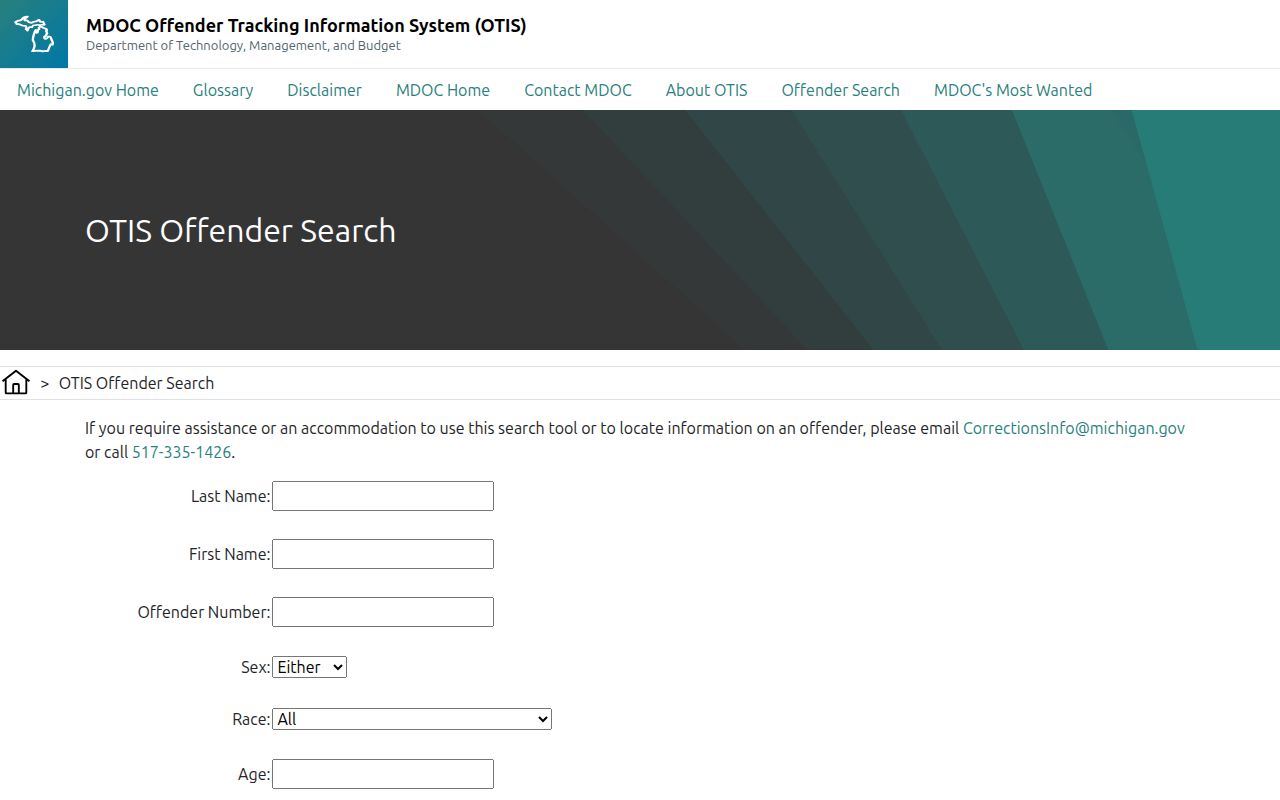
The search fields help locate a profile, while the profile’s Date Paroled, Current Status, and Discharge Date establish what happened next.
Note: An OTIS earliest release date or maximum date is not proof that an Oakland County offender actually left prison.
Michigan Parole Versus Discharge
Parole is release from prison into the community while the person remains in MDOC legal custody and under supervision. OTIS “Date Paroled” is the completed prison-exit field. The person is outside the prison but has not yet reached full MDOC discharge. A parole condition, violation, absconder status, or new legal event can affect what follows.
“DISCHRG” means MDOC jurisdiction ended for the sentence. OTIS explains that discharge can follow successful parole or probation completion, service of the prison maximum without parole, or death in the defined circumstance. A death discharge must not be called a community release. Read the discharge reason and sentence table rather than assuming every discharge describes the same outcome.
| Status | Physical location | MDOC authority |
|---|---|---|
| Prisoner | In state prison custody | Continues |
| Parole | In the community under supervision | Continues |
| Discharged | Depends on discharge reason and later events | Ended for the shown sentence |
| Parole absconder | Community whereabouts unresolved | Continues; actively sought by MDOC |
The Oakland County Probation & Parole page provides the Region 10 office path when the OTIS status shows ongoing community supervision.
Michigan Prison Release Date Rules
Michigan uses indeterminate sentences for most state-prison cases. The judgment sets a minimum and maximum. MCL 791.234 gives the Parole Board jurisdiction after the governing minimum, adjusted only by lawfully applicable legacy credits. The Board may grant, deny, or defer release under its statutory standard. Reaching the earliest release date does not require parole.
Michigan is not a generic 85-percent state. MDOC explains that truth in sentencing requires service of the full judicial minimum before parole consideration for covered modern crimes. It removed good-time and disciplinary-credit reductions for assaultive crimes committed on or after December 15, 1998, and for all other crimes committed on or after December 15, 2000. Disciplinary time for major misconduct is considered by the Board.
Older eligible offenses can fall under legacy good-time or disciplinary-credit rules. Good time generally applied before April 1, 1987, while disciplinary credits applied to eligible offenses after that date and before the truth-in-sentencing cutoff for the offense category. Never apply an older credit rule to a modern offense because a profile includes a date field.
Consecutive sentences can aggregate minimums for Board jurisdiction and maximums for discharge. Parole violation, rescission, a new sentence, appellate correction, or a later credit determination can move a date. Capture the field label and lookup date rather than presenting one old screen as a fixed promise.
Michigan Prison Release Records
OTIS is a public status system, not the entire state corrections file. For a formal or older record, request an existing discharge certificate, date-paroled or status history, or releasable offender photograph from MDOC. Identify the person and MDOC number. Ask narrowly and allow lawful redaction.
Michigan Department of CorrectionsGrandview Plaza, 206 East Michigan Avenue
P.O. Box 30003, Lansing, MI 48909
General: 517-335-1426, Monday through Friday, 8 a.m. to 5 p.m.
FOIA: MDOC-FOIA@michigan.gov, 517-335-4194
Current prisoner-record questions go to Corr_Records_Info@michigan.gov. Past records up to six years after release go to MDOC-Records_Retention@michigan.gov. General accuracy questions may be sent to CorrectionsInfo@michigan.gov. If an OTIS field came from a court record, MDOC directs correction of that source through the sentencing court.
MDOC Policy Directive 01.06.110 states a five-business-day response period and one ten-business-day extension. The policy lists ten cents per page plus postage, limited labor or redaction fees in 15-minute increments, waiver of totals at or below $50, and possible deposit requirements above that amount. Verify the current policy when making the request.
Presentence reports, victim statements, LEIN information, set-aside records, protected treatment data, and other exempt material can be withheld. The PENPACK is not a public shortcut; MDOC limits that certified package to recognized criminal-justice authorities for official business.
Note: An MDOC records response can outlast the public OTIS profile and clarify state custody after the online retention period ends.
Michigan Discharge Record Retention
OTIS keeps discharged information public for three years after discharge from MDOC supervision, or three years after the most recent discharge if supervision resumes. After that period, a missing profile does not prove the person was never imprisoned or never released. The sentencing-court file and MDOC records route may last longer than the public page.
Michigan set-aside law can also change public visibility. An order or automatic set-aside can make specified conviction, arrest, fingerprint, and sentence material nonpublic to general users while preserving authorized government access. A removed OTIS result can reflect lawful set-aside operation, search mismatch, or retention limits. It must not be turned into a claim that no custody event occurred.
- ERD
- Earliest release date or Parole Board jurisdiction date; an eligibility point, not an exit.
- Date Paroled
- The date the person actually left state prison for parole.
- Discharge Date
- The end of MDOC jurisdiction for the sentence shown.
- Inactive sentence
- A sentence entry no longer active in the way OTIS defines, with its own dates and reason.
Oakland to Michigan Prison Transfer
An Oakland felony begins in district court and moves to Sixth Circuit after bindover. When the judgment commits the defendant to MDOC, OCSO transfers the person from the county system. County roster disappearance at that point means custody changed systems. It is not a county release to the community.
Confirm the chain with the Oakland court judgment, the OCSO booking disposition when available, and OTIS. The court supplies the sentence authority. The county record documents the booking end and transfer. OTIS then supplies the state location, sentence table, parole date, current status, and discharge date. If the state profile has aged out or contains an unresolved field, use MDOC records and the court file.
MI-VINE can send supported state custody notices, but it is a live event service rather than a permanent discharge archive. Preserve the exact event and compare it with OTIS. Federal BOP, USMS, and ICE systems are separate and should be used only if the individual record shows federal or immigration custody.
The Oakland County search and records paths on Home help distinguish the initial county booking from the later state-prison release.
Note: Date Paroled confirms a Michigan prison exit; Discharge Date confirms the later end of MDOC control for the sentence shown.