
Oakland County Release Outcomes
A release entry closes one Oakland County Jail booking, but it does not always mean that a person walked free. Bond, time served, dismissal, and a scheduled outdate can lead back to the community. Other entries may record a move to Michigan Department of Corrections custody, another county, the U.S. Marshals Service, or immigration custody. A tether placement can move someone out of a jail bed while court and program controls remain in force. For that reason, the recorded disposition and destination matter more than simple absence from the live roster.
Different agencies keep different parts of the story. The Oakland County Sheriff’s Office records booking and release activity. The court supplies the order or case event that authorized the change. MDOC tracks a prison sentence, parole, probation, and later discharge. MI-VINE can announce a custody event, while federal and immigration transfers require their own systems. A sound finding joins the release timestamp to the legal event and any next custodian.
- Time served
- The custodial term has been satisfied, subject to other lawful holds.
- Parole
- Release from prison into community supervision while MDOC legal custody continues.
- Probation
- Court-ordered supervision that may follow a jail term or occur without state prison.
- Discharge
- The end of MDOC jurisdiction for the sentence shown in OTIS.
Oakland County Release Types
The release type directs the next check. Bond resolves custody for the moment, not the criminal charge. A dismissal can end one case while another hold remains. Parole is an actual prison exit but not the end of the sentence. A transfer closes the Oakland booking while custody continues somewhere else. The distinctions below keep a release search tied to the right record system.
| Recorded outcome | What it means | Best next source |
|---|---|---|
| Bond | Release under a court-set promise or security to return | District or circuit court docket and OCSO release record |
| Time or sentence served | Local custodial term completed, if no other hold applies | OCSO timestamp and sentencing court |
| Dismissal | That case no longer supports detention | Court order, then check for other cases or holds |
| MDOC transfer | State-prison custody begins | MDOC OTIS after state intake |
| Parole | Prison exit into MDOC supervision | OTIS Date Paroled and Current Status |
| Other authority | Custody continues with another county, USMS, BOP, or ICE | The receiving authority’s record or court docket |
Why did an Oakland County inmate disappear from the roster? The CLEMIS current list is a custody view, not a permanent archive. A missing name means the current search did not return that booking. It does not prove a community release, so the 72-hour release view, OCSO records, court action, and possible transfer source must be checked.
Note: A transfer closes the Oakland booking but keeps the person in custody, so always read the destination or next agency.
Oakland County Release Record Fields
An Oakland County release record is the closing event connected to a specific booking. A focused request asks for existing fields, not a new narrative. CLEMIS confirms that the agency jail system handles booking, bonding, release, pictures, property, and VINE integration, although that does not make every internal field public. Useful public fields can establish who was booked, when the booking ended, what authority caused the exit, and whether a transfer followed.
| Field | What it establishes |
|---|---|
| Name and identifiers | The person and booking to which the event belongs |
| Booking number | The link between admission, charges, property, and release |
| Admission date and time | When Oakland custody for that booking began |
| Release date and time | When OCSO closed physical custody for the booking |
| Disposition or reason | Bond, sentence completion, dismissal, transfer, or another coded result |
| Releasing authority | The court, sentence, or agency basis for the event |
| Destination | A public transfer destination when one is releasable |
| Case and charge links | The court matters associated with the booking |
The public 72-hour CLEMIS branch is narrower. It shows a name, photo thumbnail, Released Date, Book Date, inmate ID, sex, date of birth, and a detail control. It does not show the release reason, charge, bond, or hold. Those gaps are why the quick feed cannot replace the full record or court file.
Oakland County Release Volume
OCSO’s 2023 annual report counted 12,276 admissions and 12,177 releases. The current jail page reports 12,247 admissions in 2024. These totals describe booking and release events, not unique people. A person can have more than one booking, and a release can be a transfer rather than a return to the community. The figures show why a short public window turns over quickly, but they cannot be used to infer a population or an individual result.
Each number comes from an OCSO annual or current facility source. None states that all people were fully discharged or that every exit occurred through the same jail door.
Note: Annual admissions and releases count events, and one person can create more than one event during the reporting year.
Request Oakland County Release Records
The OCSO Records Unit offers two useful routes. A former inmate can appear with government-issued photo identification and request a free proof-of-incarceration letter for specified dates. A requester seeking the fuller booking and release record should use the Oakland County FOIA portal. The request should identify the person and approximate booking, then name the release date and time, disposition, releasing authority, public transfer destination, and booking photograph.
- Collect the full name, aliases, date of birth if known, inmate or booking number, and a narrow date range.
- Describe the existing booking and release fields sought. Ask for electronic delivery and for exempt details to be redacted rather than the entire record withheld.
- Submit through the county portal. Michigan FOIA generally calls for a response within five business days and permits one written extension of up to ten business days.
- Compare the response with the court register of actions. If the record says transfer, continue with the receiving agency.
Oakland County Sheriff’s Office Records Unit
1201 North Telegraph Road, east side of the jail
Pontiac, MI 48341
248-858-5011 · ocsorecords@oakgov.com
Monday through Friday, 8:30 a.m. to 5 p.m.; arrive at least 30 minutes before closing.
The Records Unit lists a $7 cash charge for available incident reports in person. Research does not establish that amount as the fee for a release record or photo. FOIA fees may instead cover permitted search, review, redaction, copying, and mailing under Michigan’s public-records rules.
Note: A precise date range can reduce search work and cost without narrowing away the fields needed to verify the release.
Oakland Release Records and Courts
Court records explain the legal authority behind many Oakland County releases. A misdemeanor stays with the district court. A felony begins there, then moves to the Sixth Circuit after bindover. Oakland guidance says the district record becomes nonpublic at that transition, so a person searching only one court may miss the next stage. The county’s Court Explorer covers Sixth Circuit name and case-number searches, shows a free register of actions, and permits orders for public documents.
Look for a bond order, dismissal, plea, judgment of sentence, amended sentence, probation order, probation discharge, remand, or set-aside order. A court event does not always prove the exact time jail staff completed the release. Bond may still need payment and clearance. A dismissal in one case may leave another hold. Pair the order with the OCSO release timestamp, and use the applicable district court for misdemeanors or a felony before bindover.
Online Sixth Circuit public records reach to the early 1990s. Older public files may be requested by mail or in person. Regular copies cost $1 per page. Certified copies add $10 per case number, plus the per-page charge, and payment-service fees may apply. Certification makes the copy official, but it does not turn a sentence date into proof of physical release.
Oakland Release Records After Set-Aside
Michigan’s set-aside process can change what a general user sees. Under MCL 780.621 and related Clean Slate provisions, eligible conviction, arrest, fingerprint, and sentence information can become nonpublic after an order or an automatic process. Authorized government access may remain. A removed court or OTIS result therefore does not prove that no Oakland booking occurred, and a historical release should not be reconstructed from a negative search alone.
Michigan FOIA, MCL 15.231 through 15.246, favors access to public-body records subject to exemptions. Courts acting in a judicial role follow court-access rules instead. Juvenile, sealed, set-aside, personal protection, and mental-health matters may be withheld or omitted. A release request should seek segregable public fields and accept lawful redaction. Children’s Village information is not an adult inmate source, and juvenile identities must not be placed into an adult release search.
Note: A missing public record can reflect a lawful access restriction, expired display period, search mismatch, or a system that never covered the custody.
Find Oakland County Released Inmates
Start with the kind of custody, not with a broad name search. An Oakland arrest and county-jail booking call for CLEMIS, OCSO records, and the court. A state-prison sentence calls for OTIS. A federal sentence calls for the BOP locator, while a federal pretrial matter depends on the court because USMS offers no public inmate locator. Immigration custody requires ICE ODLS. The sequence below protects against treating a transfer as freedom.
- Open the official OCSO inmate-information route and select Oakland County Jail in CLEMIS. Check the current and released-within-72-hours views.
- If the booking is older or the result is unclear, call Inmate Information at 248-858-1800 or email PrisonerInfo@oakgov.com. Ask whether the booking ended by release or transfer.
- Search the correct district court or Sixth Circuit record for the order or disposition tied to the booking.
- If a prison sentence followed, use MDOC OTIS and read Current Status, Date Paroled, and Discharge Date with the sentence fields.
- Use MI-VINE for a custody-event alert, then confirm its exact event with the agency record. Use BOP or ICE only when those systems fit the custody.
- Request the OCSO release record when the public views have expired or do not state the disposition.
Oakland County CLEMIS Release Search
Oakland County has a genuine recent-release feed, but it sits behind the normal locator workflow. Open the official CLEMIS locator, complete the access check, choose Oakland County Jail, and then select “released within the last 72 hours.” The deeper results route depends on that selected-jail session. There is no separate official 24-hour release view. A reader can compare the Released Date with the current time, but that is not the same as an official server-side 24-hour filter.
The page client refreshes every 300 seconds. That means the browser asks for new display data every five minutes. OCSO separately warns that the underlying information can be as much as 72 hours out of date depending on the day. Refresh rate and record freshness are different facts. Save the lookup time and retry when the release was just processed. After the rolling window expires, move to OCSO Records, MI-VINE, and the court instead of expecting a longer sheriff archive.
The CLEMIS released view shows how the result table presents the short window.
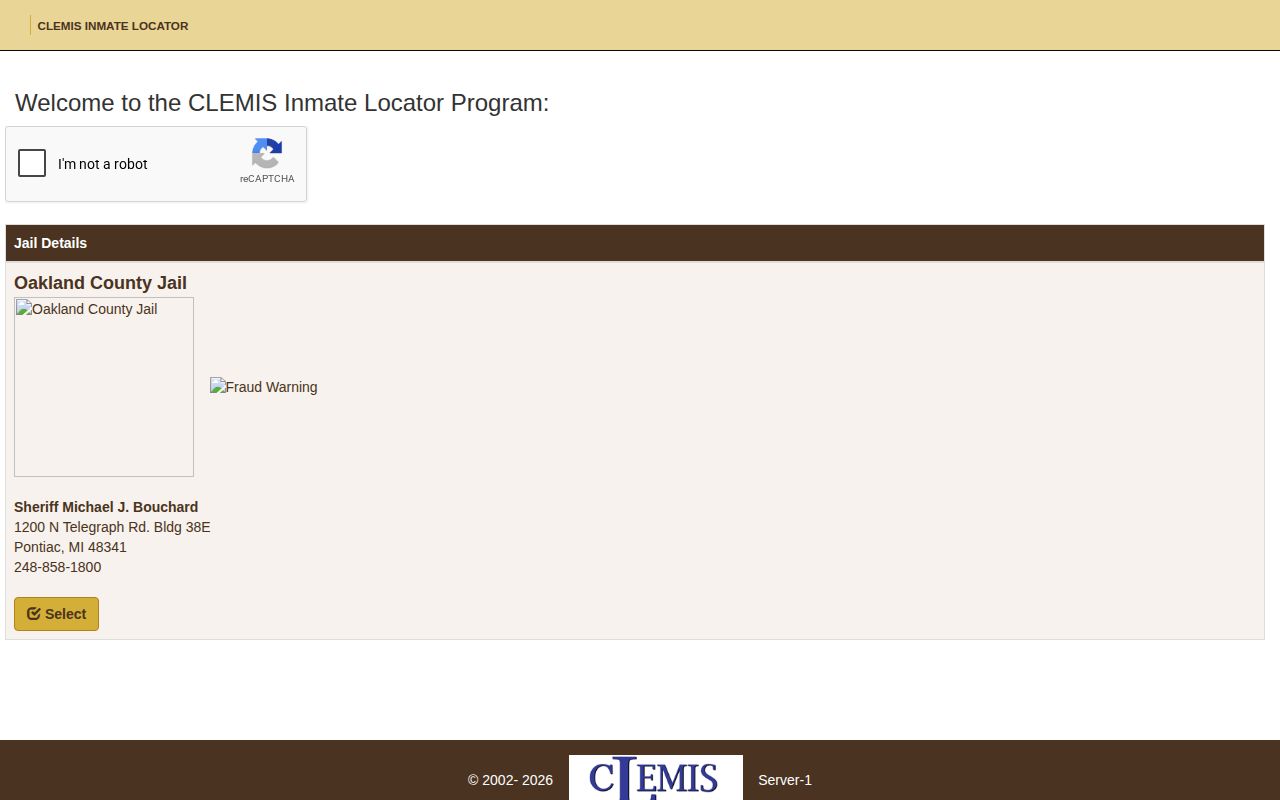
The screen is useful for a recent timestamp and photo, while the OCSO record and court remain necessary for the reason or authority.
Note: CLEMIS page refresh occurs every five minutes, but the sheriff’s separate warning allows much older underlying information.
When Oakland Jail Releases Inmates
Oakland publishes unusually specific scheduled-outdate instructions. The person meeting the inmate checks in at the Bonding window. Staff then run a current Law Enforcement Information Network check for holds, warrants, or detainers. If the person clears, OCSO says processing occurs as close to 12:01 a.m. as possible. Staff tell the waiting person when clearance is complete, that person returns to the car, and the released person is directed there.
The process shows why a calculated date is not final proof. A warrant, hold, or detainer can stop the planned community exit or cause a transfer. The Bonding Area operates at all times and accepts regular, surety, interim, and fines-and-costs bonds under its published rules. Cash bonds of $10,000 or more are processed by the court of jurisdiction. A bond release can also carry pretrial reporting or electronic conditions, so “bonded out” does not mean the criminal case or all supervision ended.
Note: The published midnight procedure applies to a scheduled outdate after clearance, not to every bond, court, or transfer release.
Getting Home After Oakland Release
OCSO Program Services states that its religious program may provide clothing and bus tickets to people who lack transportation at release. No official route, stop, rideshare rule, or broad waiting-zone instruction was found. The only specific pickup direction applies to a scheduled outdate after Bonding-window clearance. Those limits matter because release logistics should not be filled with assumed local transport details.
After release, a former Oakland inmate may sign into SmartInmate with the inmate number and password to download postal mail, messages, and photos without charge. That is a private continuity tool for the former inmate, not a public records archive. Physical property questions go to OCSO at 248-858-8770. No detailed public property-pickup procedure was located, so the property line should confirm the current process before a trip.
MDOC Search for Oakland Releases
The Michigan Department of Corrections OTIS page covers prisoners, parolees, probationers, and people within three years after discharge from MDOC supervision. It does not cover a person whose only custody was an Oakland County jail or municipal lockup. Search by the six-digit MDOC number when known. Otherwise, use at least the required part of the last name and add first name, age, identifying marks, or status to narrow the results.
- Current Status
- Prison, parole, probation, discharged, or an absconder category.
- Parole Board Jurisdiction Date / ERD
- The first eligibility date, not a promised release.
- Maximum Date
- The potential maximum under the sentence and applicable rules.
- Date Paroled
- The actual prison exit into parole supervision.
- Discharge Date
- The end of MDOC jurisdiction for the sentence.
- Sentence detail
- The offense, statute, county, court file, dates, and active or inactive status.
The OTIS search form includes Discharged, Parolees, and other status choices.
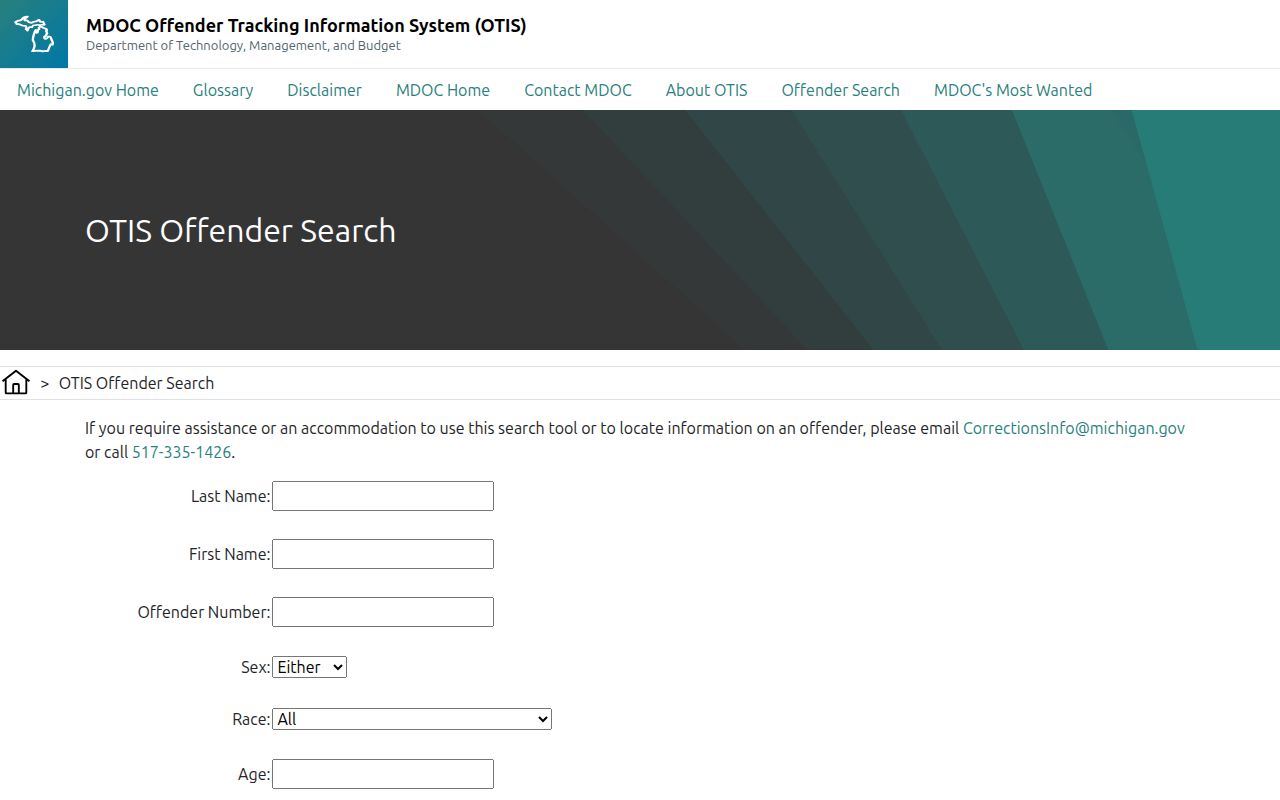
A Discharged result confirms the later end of MDOC control. A Parole result means the person is outside prison but remains under supervision.
Oakland Post-Release Supervision
Parole and probation are not interchangeable. Parole follows prison and keeps the person in MDOC legal custody. Probation is imposed by a court and may follow county jail or no incarceration. OTIS can show MDOC-supervised parole or probation, including discharged and absconder statuses. Region 10 serves Oakland County through Northwest Operations, Oakland Probation, Pontiac Parole, and Troy Probation. The office matching the supervision type and location is the sound verification contact.
The Michigan Parole Board makes parole decisions, but a grant is not proof that the physical exit occurred. OTIS Date Paroled supplies that later evidence. OCSO’s 2023 report also counted 773 completions across JAWS, cognitive-behavioral, home-confinement, and work-release-tether programs, with 18,961 jail-bed days saved. Those figures give local context and do not show that a named person completed any program. Detailed verification paths appear on the Oakland County probation and parole page.
Oakland Release Alerts and Transfers
MI-VINE is Michigan’s free, confidential custody and court-status notification service. It connects county-jail and MDOC information and can send release, transfer, escape, hearing, case-status, or disposition notices by supported phone, text, email, app, and accessibility channels. Search VINELink after choosing Michigan and the matching jurisdiction. A release alert is a prompt to verify. It is not a permanent archive, and a transfer event must not be read as community release.
Federal paths are separate. The BOP locator shows a release date and “Released” or “Not in BOP Custody” for federal prison records, but another authority or supervision may follow. USMS handles many federal pretrial detainees and provides no public inmate locator, so the federal court docket and counsel or court contacts control that search. ICE ODLS accepts an A-number and country of birth, or an exact name and country of birth. No ICE result is conclusive by itself, and no official evidence shows a current Oakland County Jail ICE detention contract.
Note: A custody notification records an event in one system and should be compared with the court or next authority before drawing a conclusion.
Oakland Release Status by System
A source is reliable only for the custody it covers. The current Oakland roster can confirm a displayed jail booking, but it is the wrong tool for a release that has already left its live scope. OTIS can prove a prison parole or discharge and still say nothing about a jail-only sentence. Federal and immigration tools are narrower still.
| Question | Source | Key limit |
|---|---|---|
| Still in Oakland jail? | CLEMIS current view | Can lag; no match is not proof of release |
| Released from Oakland jail recently? | CLEMIS 72-hour released view | Short window and limited fields |
| Why and when did the booking end? | OCSO release record plus court | Protected fields may be redacted |
| Left Michigan prison? | OTIS Date Paroled | Parole supervision continues |
| Finished MDOC control? | OTIS Discharged and Discharge Date | Public profile generally remains three years |
| Left federal prison? | BOP locator | Does not rule out another custodian |
| In immigration custody? | ICE ODLS and DRIL | Exact-match and privacy limits apply |
Oakland County Release Facilities
The Oakland County Jail, including its Main Jail and attached Annex, is the main adult county detention site. The separate East Annex is closed and houses no inmates. Community Corrections covers tether and other alternatives that can place a person outside a jail bed while controls remain. Municipal police lockups are short-term local holding areas, not one countywide long-term jail system. Children’s Village serves juveniles and is excluded from adult release searches.
No operating MDOC prison or BOP institution was identified inside Oakland County. Oakland defendants sentenced to state prison may be held anywhere in Michigan, so OTIS is the statewide path. USMS contract custody can use local, state, or private beds without turning a federal detainee into an ordinary county release. ICE detention requires its own locator and contact route. The Main Jail dates to 1973, its attached Annex to 1989, and the former Work Release building became East Annex in 2010 before closing. Electronic tether replaced in-jail Work Release, making the current status more important than the building name.
- Oakland County Jail: adult county booking, custody, release, and transfer records.
- Oakland County Jail East Annex: closed historical satellite with no current releases.
- Oakland County Community Corrections: tether and supervised alternatives.
- Oakland County Children’s Village: juvenile campus with restricted records.
- Oakland County Municipal Police Lockups: short-term arresting-agency custody.
- Michigan State Prisons: statewide MDOC custody and OTIS release path.
- Federal Prisons, U.S. Marshals Custody, and ICE Detention: distinct federal systems.